
 By
By Summary
X, formerly Twitter, has released a major amount of the code used to determine which posts appear in its “For You” feed, including the default weights used for many predicted user actions. The release gives creators, marketers, and business owners a rare look at how X decides which posts deserve more distribution. (x.com)
Some of the biggest findings are:
- Replies appear to be substantially more important than Likes.
- Shares through copied links appear to be extremely valuable.
- Direct Message shares, Quotes, Replies, and new follows are all strong positive signals.
- Clicking an outbound link is a positive, not negative, ranking signal in the published scoring weights.
- Reports, Mutes, Blocks, and “Not Interested” actions can have massive negative impacts.
- X deliberately reduces the visibility of multiple posts from the same author appearing together.
- Posts from accounts a user does not follow receive a scoring discount.
- X has systems specifically designed to give newer/smaller creators an opportunity to get exposure.
- Posts older than 48 hours are filtered from this For You recommendation pipeline.
- X now uses a Grok-derived transformer called Phoenix to predict what an individual user is likely to do with every candidate post.
There is one extremely important caveat: the numbers being shared online are not a simple points system.
If the algorithm gives Replies a weight of 5 and Likes a weight of 0.5, that does not necessarily mean getting one Reply is exactly equivalent to getting 10 Likes.
X predicts the probability that a specific user will perform each action and then multiplies those probabilities by these weights. X itself also notes in the code that the weights reflect both how much it values an action and how common or uncommon that action normally is across the platform. (raw.githubusercontent.com)
That distinction is important.
With that out of the way, there is a ton here that creators and marketers can actually use.
X Just Gave Us a Rare Look Inside a Major Social Media Algorithm
Social Media algorithms are normally a frustrating black box.
You create a post.
It gets 37,000 impressions.
You create another post that you believe is dramatically better.
It gets 483 impressions.
Then a guy with 142 followers posts a blurry screenshot and somehow gets 2 million views.
Marketers have spent roughly two decades trying to reverse engineer why this happens.
X has now given us far more information than most major social networks are willing to provide.
The open-source repository contains the core code involved in retrieving posts, ranking them, filtering them, understanding their content, and deciding whether they can appear in someone’s For You feed. The August 13th, 2026 update also added key configuration parameters including the weights used to combine predicted actions into a final ranking score.
X has also started rolling out an “Under the Hood” transparency tool designed to show users visibility-impacting labels that have been placed on their accounts and posts. (github.com)
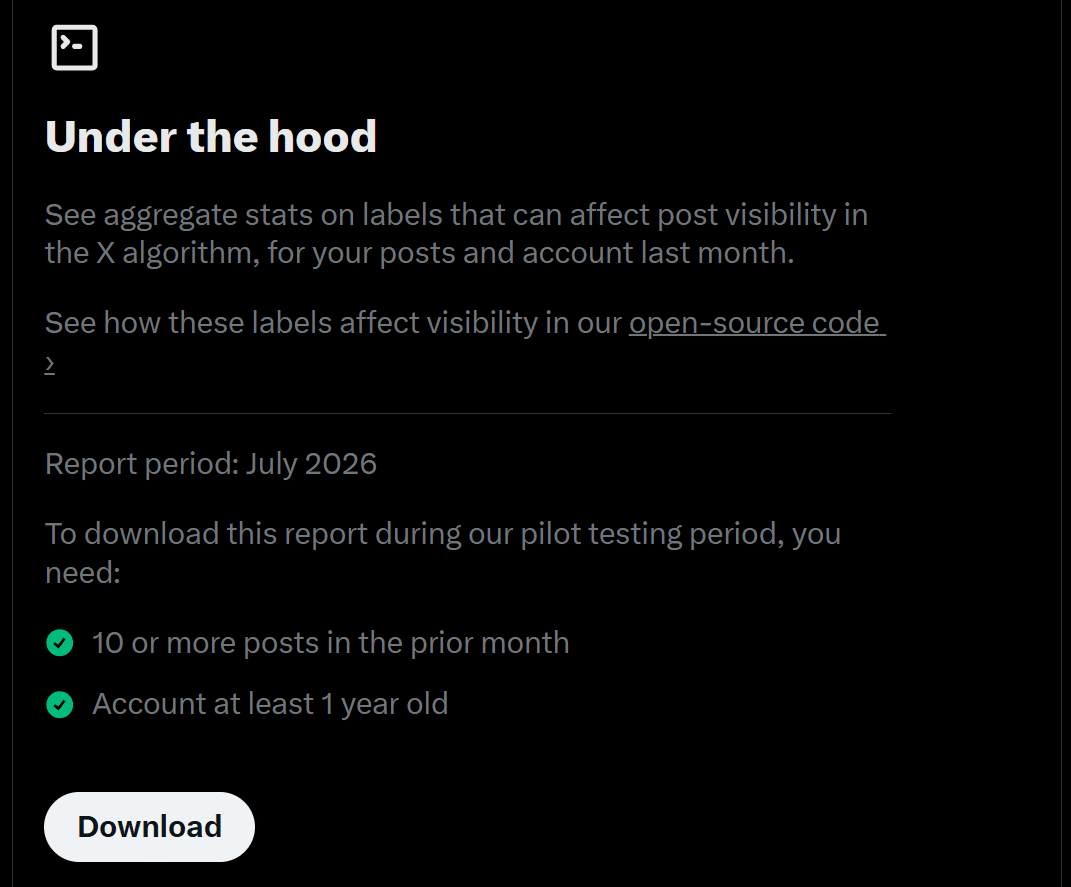
This is a pretty big deal.
It does not mean every mystery about X has suddenly been solved. Some anti-abuse rules and Grox prompts are intentionally being withheld to make the algorithm harder to game, and X continuously runs experiments which can change these values for portions of its users. X says the defaults published in the repository are synced with its primary production values. (github.com)
So consider this a map of how X works today, not the Ten Commandments permanently engraved on a stone tablet somewhere in Austin.
How X Builds Your “For You” Feed
Before looking at the weights, you have to understand where the posts being ranked actually come from.
X essentially has two major buckets of content.
1. Posts From People You Follow
A system called Thunder keeps recent posts from accounts you follow available for retrieval.
2. Posts From People You Do Not Follow
This is where things get more interesting.
X uses both Phoenix Retrieval and SimClusters to find posts that it believes you might like from accounts you are not already following.
Phoenix represents users and posts mathematically and looks for content that appears to be relevant to that particular user. SimClusters attempts to understand communities based on who engages with what and can then retrieve content associated with those communities.
This is extremely important for creators.
Your followers are no longer your maximum potential audience.
X is actively trying to find people who don’t follow you but might like your content.
Once X gathers these candidate posts, it hydrates them with additional information such as the post text, media, author information, language, engagement counts, subscription status and various labels. It then begins filtering and ranking them.
Phoenix Doesn’t Really Ask “Is This a Good Post?”
This might be my favorite part of the entire release.
Phoenix isn’t trying to determine whether your post is objectively “good.”
Instead, it is effectively trying to answer a bunch of questions about the person looking at X.
Things like:
- Will this person Like this post?
- Will they Reply?
- Will they Repost it?
- Will they Quote it?
- Will they send it to someone?
- Will they copy the link?
- Will they click the author’s profile?
- Will they follow the author?
- Will they open a photo?
- Will they watch the video?
- Will they click a link?
- Will they spend time reading it?
- Will they hit “Not Interested”?
- Will they Mute the author?
- Will they Block the author?
- Will they Report the post?
Phoenix predicts the probability of those actions and the ranking system combines those predictions into a score. (github.com)
In simplified form X describes this as:
Final Score = Sum of Weight × Predicted Probability of Action (github.com)
That means the real battle isn’t necessarily:
“How do I make a viral post?”
It is closer to:
“How do I create a post the algorithm can confidently match with people who are likely to do something meaningful with it?”
That is a very different marketing problem.
The X Algorithm Weights
A post by X user Vittorio (@IterIntellectus) helped draw attention to these weights by turning them into graphics that quickly began circulating around the platform. I went back to X’s actual published code to verify them rather than relying solely on the graphics. (x.com)
they actually posted the weights of the algorithm https://t.co/asJ3GrUQSQ pic.twitter.com/8Q9dyPofen
— vittorio (@IterIntellectus) August 13, 2026
Here are some of the most important default values currently published by X:
| Predicted Action | Published Weight |
|---|---|
| Share via Copy Link | +20 |
| Reply | +5 |
| Quote | +5 |
| Share via DM | +5 |
| Follow Author | +4 |
| Share | +2 |
| Repost | +1 |
| Like / Favorite | +0.5 |
| Click Post | +0.4 |
| Open External Link | +0.2 |
| Photo Expand | +0.05 |
| Video Open | +0.05 |
| Video Quality View | +0.05 |
| Not Dwelled | -0.02 |
| Block Author | -31.2 |
| Not Interested | -43.2 |
| Mute Author | -58.8 |
| Report | -234 |
These are the published defaults in X’s source code as of this writing. (raw.githubusercontent.com)
Again, don’t look at that table and conclude:
“One copied link equals 40 Likes.”
The algorithm isn’t simply adding points after the engagement occurs.
It is multiplying the weight by Phoenix’s predicted probability that the viewer will perform that action.
X even placed a comment directly above these parameters explaining that the weights incorporate both the value X places on an action and the typical propensity of users to perform it. Negative feedback, for example, is relatively rare, which helps explain why some of its negative coefficients are enormous. (raw.githubusercontent.com)
Still, the relative values tell us quite a bit.
1. Stop Obsessing Over Likes
Creators love Likes because they are visible.
Clients love Likes because they are easy to understand.
Social Media reports love Likes because you can make a nice little chart showing that you got 14% more Likes this month.
X doesn’t appear nearly as impressed by them.
The published Reply coefficient is ten times the Like coefficient. Quotes are also weighted at 5. Shares via DM are weighted at 5. A generic share is weighted at 2. (raw.githubusercontent.com)
Likes certainly help.
But a post that makes someone do something appears much more interesting to X than one people passively tap a heart on while scrolling.
For creators this means your content should give people something to talk about.
Ask interesting questions.
State an opinion worth responding to.
Share data people want to challenge or discuss.
Teach something someone might want to add to.
Tell a story that makes people want to share their own experience.
The old advice that “engagement matters” wasn’t wrong.
It was just hopelessly vague.
2. Make Content People Want to Send to Someone Else
The most eye-popping number in the standard positive weights is this:
Share Via Copy Link: +20 (raw.githubusercontent.com)
Sending something through a DM also carries a strong +5 coefficient.
That tells us something bigger than “add a share button.”
Create things worth passing around.
Think:
- Original research
- Useful charts
- Checklists
- Breaking information
- Strong opinions
- Funny posts
- Surprisingly useful tips
- Templates
- Statistics
- Industry news
- Resources someone wants to send to a coworker
- Content that makes somebody immediately think, “I need to send this to Sarah.”
That final category might be one of the most important.
A Like says:
“I enjoyed this.”
A share says:
“Someone else needs to see this.”
X appears to care quite a bit about the difference.
3. Outbound Links Do NOT Appear to Have a Direct Negative Weight
For years creators have been told some version of:
“Never put a link in your post because the algorithm will kill it.”
At least in X’s currently published main scoring parameters, clicking an outbound link is positive.
The OpenLinkWeight default is +0.2. (raw.githubusercontent.com)
That does not mean posts with links will automatically perform just as well as native content.
A link click has a relatively small coefficient compared to a Reply, Quote, Follow, DM Share or copied-link share. And sending users away from X naturally removes opportunities for them to perform additional actions on the platform.
But I don’t see evidence in the published weighted scorer of some simple rule that says:
External Link = Penalty
That’s an important distinction for publishers, creators and businesses.
If your objective is website traffic, I would not suddenly stop linking to your website because somebody on X told you that links are algorithmically poisonous.
Instead, make the post itself valuable enough that people interact with it and click the link.
4. Replies Are Especially Interesting When People Mutually Follow Each Other
X added another fascinating adjustment in July 2026.
Original posts from people who mutually follow each other can receive an additional boost to the weight placed on the probability of a Reply.
X tested multiple values and eventually set the primary published default for this Bidirectional Follow Reply Weight Boost at 15. (github.com)
In plain English:
X apparently wants conversations between people who actually know, follow, or regularly interact with one another to appear more prominently.
That is a strong argument for building a community, not merely accumulating followers.
A creator with 25,000 people who barely interact with them may not have as useful of a network as someone with 5,000 people who actually know them, follow each other, talk and interact regularly.
Do not interpret this as:
“Follow 20,000 random people so they follow me back.”
X has entire systems designed to identify inauthentic behavior.
Instead, build real relationships in your niche.
I know, groundbreaking Social Media advice in 2026: actually be social.
5. Ragebait Is Playing With Fire
You could look at the +5 Reply coefficient and decide the obvious strategy is to make everyone angry.
That might work.
Until it doesn’t.
Look at the negative coefficients:
- Not Interested: -43.2
- Block Author: -31.2
- Mute Author: -58.8
- Report: -234 (raw.githubusercontent.com)
Those numbers are huge.
Again, these are probability-weighted values and negative actions occur less frequently, so don’t compare them literally one-to-one with Likes.
But the general message is hard to miss.
Creating disagreement can be good.
Creating content that makes people want you removed from their feed entirely is something else.
That distinction is especially important for brands.
A controversial opinion might generate a lot of discussion from an audience that still likes hearing from you.
Constantly annoying people until they hit Mute is not the same strategy.
6. Posting Constantly Can Make Your Own Posts Compete With Each Other
Here’s something I have seen almost nobody discussing.
After X creates its initial ranking score it applies something called Author Diversity.
If multiple posts from the same person could appear in the same feed, posts after the first receive a decaying multiplier. The current published defaults enable this system with a decay value of 0.5 and a floor of 0.25. (raw.githubusercontent.com)
This appears designed to stop someone’s For You feed from looking like:
Joe
Joe
Joe
Joe
Joe
Random Person
Joe
Joe
even if all of Joe’s posts individually scored well.
For creators this means machine-gunning mediocre posts all day might cause your own content to compete for the same available attention.
I’m not saying there is a magical ideal number of posts per day buried in this code.
There isn’t.
But the algorithm explicitly prefers some author diversity within a feed.
I would rather publish fewer things people actually want to discuss and share than dump 35 pieces of filler onto X because some Social Media guru told me posting every 17 minutes is the growth hack of the week.
7. Original Posts Appear Better Suited for Discovery Than Replies
X treats Replies and Reposts differently depending on where they came from.
Out-of-network Replies and Reposts can be filtered before scoring, while Replies and Reposts from followed accounts can receive the same discount used for other out-of-network content. (github.com)
That means creators trying to reach new people should probably put their strongest ideas into original posts rather than hiding everything inside Replies.
Replies are fantastic for community building.
They can also help people who already know you continue interacting with you.
But if you have something important you want X to potentially distribute broadly, make it an original post.
8. There Is an Explicit Disadvantage to Being Out-of-Network — But X Also Needs Out-of-Network Content
Posts from accounts the viewer does not follow currently receive an Out-of-Network Weight Factor of 0.75 after scoring. (raw.githubusercontent.com)
So yes, being followed by someone helps.
But don’t miss the other half of the equation.
X has built two entire systems — Phoenix Retrieval and SimClusters — specifically to discover content from people the viewer doesn’t follow. ~~~~~~~~~~~~~~~~~~~~~~
That is the engine that allows a creator with a relatively small audience to suddenly reach hundreds of thousands of people.
The post starts at something of a disadvantage.
But if Phoenix believes it is unusually well matched to that viewer and predicts enough valuable actions, it can overcome that disadvantage.
This is one reason creating content for a specific audience matters.
Generic content gives the algorithm a much harder matching problem.
9. Pick Topics and Become Identifiable With Them
Phoenix looks at a viewer’s recent engagement history, while SimClusters uses patterns in who engages with what to discover related content and communities. ~~~~~~~~~~~~~~~~~~~~~~
This creates an obvious strategy for creators and solopreneurs:
Give X enough information to understand what you are about.
If Monday you post plumbing advice, Tuesday you post cryptocurrency memes, Wednesday you post 19th-century French poetry, Thursday you post Fortnite videos and Friday you announce that you’re a B2B SaaS marketing expert, you are making the recommendation problem harder.
Humans won’t know why they should follow you either.
You don’t have to become boring or talk about exactly one topic forever.
But having a recognizable collection of subjects, expertise, interests and communities should make it easier for recommendation systems to understand where your posts belong.
10. X Appears to Deliberately Give Smaller Creators a Chance
One of the more encouraging findings is an explicit New-Author Boost.
After the primary scoring stage, X says posts from authors with impressions below a threshold can be lifted toward a target feed position. (github.com)
The configuration also contains cold-start parameters tied to impression counts, followers and post age. (raw.githubusercontent.com)
In other words:
Being small does not necessarily mean being invisible.
The system appears intentionally designed to explore content from creators who have not already accumulated massive distribution.
This is smart for X because otherwise the same giant accounts would eventually consume the entire platform.
It’s also good news if you are starting a new brand or personal account.
You do not necessarily need 100,000 followers before the system will test your content.
You need content that performs well when X gives you the test.
11. Your For You Feed Has a Strong Freshness Bias
X’s published pre-scoring filters remove posts older than 48 hours from this recommendation pipeline. (github.com)
This doesn’t mean the post disappears from X.
People can still find content through other surfaces such as your profile, links or potentially search.
But for the For You recommendation system we’re examining here, the window is extremely fresh.
That means X is not Pinterest.
You probably shouldn’t expect the platform’s main recommendation feed to suddenly resurrect a six-month-old post and send it viral.
If something you created remains important, consider revisiting the idea later with a new original post rather than assuming the old post will magically come back from the dead.
12. Don’t Confuse Visibility With Ranking
There are actually two separate problems your content has to survive.
The first is ranking.
How valuable does X think this post will be for this specific viewer?
The second is visibility.
Is X willing to show the post to this person at all?
X’s documentation makes this separation explicit. Ranking determines order, while a separate visibility-filtering system can Allow a post, place it behind an interstitial, or Drop it completely. (github.com)
The visibility system uses things like account labels, post labels, viewer settings, blocks, mutes and other signals. X also runs classifiers looking for spam, adult content, violent media, inauthentic behavior and other categories. (github.com)
This is another reason obsessing over the public engagement weights alone is a mistake.
You could theoretically create the most engagement-optimized post in human history.
If another part of the system decides it shouldn’t be recommended, your beautiful +20 copied-link probability isn’t going to save you.
What I Would Do If I Was Trying to Grow on X Right Now
Based on the code X has released, I would focus on the following:
- Create original posts around recognizable topics. Give Phoenix and SimClusters a clear idea about which audiences your content belongs with.
- Optimize for Replies and discussion instead of Likes alone. Give people something worth contributing to.
- Make highly shareable content. Original data, useful resources, funny observations, charts, lists and information people want to send privately appear especially attractive based on the scoring system.
- Build actual relationships. Mutual follows and real community interaction appear to have algorithmic value.
- Do not automatically fear outbound links. Link opens currently have a positive published weight. Create posts good enough to generate native engagement and traffic.
- Don’t overpost garbage. Author Diversity means your posts can compete with one another for space in a feed.
- Avoid creating an audience that hates you. Replies are good. Reports, Mutes, Blocks and “Not Interested” actions are very much not good.
- Put your best discovery content into original posts. Replies appear to face more restrictions for out-of-network distribution.
- Pay attention to the first 48 hours. That appears to be the maximum age allowed through this specific For You candidate pipeline.
- Convert rented attention into something you own. X can change every one of these parameters tomorrow.
That final point might be the most important.
Remember: Your X Audience Is Still a Rented Audience
I have written before about the importance of building an Owned Audience.
This algorithm release does not change that advice.
It reinforces it.
X can give you tremendous reach.
Phoenix can take somebody with a relatively tiny following and introduce their work to millions of people who have never heard of them.
That’s incredible.
Use it.
But you don’t control Phoenix.
You don’t control these weights.
You don’t control the visibility rules.
You don’t control whether the out-of-network multiplier stays at 0.75.
You don’t control whether ReplyWeight is 5 next month.
In fact, X openly says it continuously experiments with these parameters and intends to make significant experiments visible through changes in the repository. (github.com)
So use X as a discovery engine.
Turn that discovery into customers, website visitors, newsletter subscribers, app users, podcast listeners, community members or whatever type of audience you can directly reach later.
Algorithms are wonderful when they’re working for you.
They are a lot less fun when somebody changes a decimal point and 80% of your reach disappears overnight.
FAQs About the X / Twitter For You Algorithm
Is a Reply really worth 10 Likes?
Not exactly.
The default Reply coefficient is 5 while the Favorite coefficient is 0.5, making the coefficient ten times larger. However, these values multiply Phoenix’s predicted probabilities of each action. They are not literal points awarded after each engagement. (raw.githubusercontent.com)
Does X penalize links?
The primary published ranking weights do not show a simple penalty for external links. The predicted probability that someone opens a link currently carries a positive weight of 0.2. Other parts of the recommendation system can still influence how a post performs. (raw.githubusercontent.com)
Are Shares more important than Likes?
The published coefficients strongly suggest X places more ranking value on predicted sharing behavior. Generic Shares have a weight of 2, DM Shares 5 and copied-link Shares 20 versus 0.5 for Favorites. Again, these operate on predicted probabilities rather than raw engagement counts. (raw.githubusercontent.com)
Do Blocks hurt your reach?
Phoenix predicts negative actions including Blocks, Mutes, Reports and “Not Interested,” and the current default weights for these actions are strongly negative. X also has account-level systems that analyze Blocks and Reports relative to positive engagement. (raw.githubusercontent.com)
Can small accounts get into the For You feed?
Yes. X retrieves out-of-network posts specifically so users can discover accounts they don’t already follow, and its documentation describes an explicit New-Author Boost for authors with relatively few impressions. (github.com)
Does X show old posts in the For You feed?
The currently published For You candidate pipeline contains an Age Filter that removes posts older than 48 hours before scoring. This applies to the recommendation pipeline documented here and does not mean the post is deleted or unavailable elsewhere on X. (github.com)
Is the entire X algorithm really open source?
A substantial amount of the code affecting For You distribution is now public, including the ranking pipeline, Phoenix model code, scoring defaults, content-understanding systems and visibility filtering. However, X explicitly says some files remain private to make gaming and abuse more difficult, including Grox prompts and some BotMaker rules. (github.com)
Closing
For creators and marketers, the most important thing I’ve taken away from X’s open-source release isn’t that a copied link has a weight of 20 or a Reply has a weight of 5.
It’s that X’s recommendation system is becoming incredibly viewer-specific.
The system isn’t merely looking around for popular posts.
It’s trying to predict:
“What is this person going to do if I show them this post from this creator right now?”
That should change how you think about Social Media content.
Don’t try to make everything appeal to everyone.
Create useful, interesting, funny, controversial, educational or entertaining things for a specific group of people who are likely to actually care.
Give them something worth discussing.
Give them something worth sending to somebody else.
Give them a reason to follow you.
Then, while the algorithm is kind enough to introduce you to strangers, do your best to turn some of those strangers into an audience you can reach without asking Phoenix for permission.
1. How This Might Impact SEO
- X can become a stronger content-discovery channel for publishers. If useful posts can reach large numbers of non-followers, X can drive meaningful referral traffic before a page has established Google rankings.
- Outbound links are not inherently “toxic” to X distribution. The published algorithm gives predicted external-link clicks a positive weight, so marketers should not automatically hide links in Replies or avoid linking to their websites.
- Create the post and the webpage together. A strong strategy would be to publish original research, data, guides, tools, or news on your website and then create an X post specifically designed to generate Replies, Quotes, Shares, and link clicks.
- X can help seed link-worthy content. Journalists, bloggers, newsletter writers, and industry experts discovering a resource on X can ultimately produce backlinks, citations, mentions, and other signals that matter much more directly to SEO.
- Original research becomes even more valuable. A statistic, dataset, chart, experiment, or surprising finding is both highly shareable on X and inherently more likely to attract backlinks.
- X can accelerate content discovery. Instead of waiting for Google or your existing audience to find a new page, a successful X post can immediately expose it to thousands of relevant people.
- Topical consistency may benefit both channels. X is trying to understand what topics and communities a creator belongs to. Building recognizable expertise around a subject also aligns well with an SEO strategy based on topical authority.
- Brand searches could increase. Viral X exposure can cause people to Google your name, company, product, or terminology you introduced, creating branded search demand.
- The strongest opportunity is probably indirect SEO. I would not interpret any of this as “X engagement improves Google rankings.” The opportunity is that X can generate traffic, awareness, links, mentions, branded searches, citations, and content discovery that can ultimately support SEO.
- SEO teams should probably stop treating social media as merely a distribution checkbox. If X can algorithmically introduce great content to enormous numbers of relevant non-followers, it can become part of the actual link acquisition and audience-development strategy.
2. How This Might Impact Social Media Marketing
- Likes should become a secondary KPI. Replies, Quotes, Shares, DM Shares, copied links, and follows appear considerably more important to X’s recommendation system.
- “Engagement” needs to be broken into individual actions. Reporting 1,000 engagements as one metric hides the fact that different types of engagement appear to have dramatically different values.
- Shareability should become a creative objective. Before publishing, marketers should ask: Would someone send this to a coworker or friend?
- Conversation is valuable. Posts should give people a reason to contribute something rather than merely agree and click Like.
- Community management may directly influence distribution. Building genuine relationships, mutual follows, and recurring conversations appears more strategically useful than simply accumulating passive followers.
- Follower count matters less than it used to. X’s recommendation systems actively search for content from people a user does not follow, giving smaller accounts opportunities to reach large audiences.
- Brands should create recognizable topical identities. Posting consistently around related subjects makes it easier for both users and recommendation systems to understand whom your content is for.
- Original posts should contain your strongest ideas. Replies are useful for community interaction, but original posts appear better suited to broad out-of-network discovery.
- Posting frequency should not be confused with posting quality. X’s Author Diversity system means flooding the platform with posts can cause your own content to compete against itself.
- Ragebait has asymmetric risk. Replies can help, but Mutes, Blocks, “Not Interested,” and Reports carry enormous negative coefficients.
- Outbound links deserve another test. Brands that have spent years burying links in the first Reply should test putting genuinely useful links directly into strong posts.
- Social teams should optimize for predicted behavior, not vanity metrics. The real question becomes: What will a member of this specific audience actually do after seeing this?
3. How to Use This Information to Go Viral
- Create posts people feel compelled to share privately. “I need to send this to someone” may be one of the most valuable reactions you can generate.
- Produce highly quotable original information. Research, statistics, experiments, rankings, charts, predictions, screenshots, and surprising discoveries naturally create Replies, Quotes, and Shares.
- Give people something to disagree with. Not manufactured ragebait, but a defensible opinion that encourages thoughtful conversation.
- Ask questions people actually want to answer. Avoid generic engagement bait. Ask questions where people can contribute expertise, experience, stories, or opinions.
- Make the audience obvious. A highly specific post for “Dallas restaurant owners,” “WordPress developers,” or “B2B SaaS founders” may give Phoenix a much clearer audience-matching signal than generic business advice.
- Create content around a repeatable topic cluster. Become identifiable with several closely related subjects so X has more confidence about which communities should receive your posts.
- Write posts that work without the link. Give away enough value inside X to generate interaction, then use the link for people wanting the full research, tool, article, or dataset.
- Engineer the “send this to Sarah” effect. Checklists, warnings, mistakes, industry news, benchmarks, templates, calculators, and little-known information work especially well for this.
- Publish things people want to Quote, not merely Repost. Give someone an idea that allows them to add their own opinion.
- Use strong visual artifacts. Charts, diagrams, screenshots, comparison tables, and original data visualizations can make otherwise complicated information instantly understandable and shareable.
- Create genuine novelty. Repeating something 5,000 other accounts have already said gives X little reason to choose your version. Give the network information, framing, data, humor, or insight it does not already have.
- Build relationships before you need distribution. A network of people who actually recognize you and interact with your content gives new posts a better environment in which to generate meaningful engagement.
- Don’t machine-gun 30 mediocre posts. Give each important post enough space to earn distribution instead of immediately competing against your next five posts.
- Watch negative feedback carefully. A post producing 400 angry Replies might look successful until you realize it also convinced dozens of people to Mute or Block you.
- Move quickly on timely subjects. With the For You pipeline’s strong freshness bias, breaking news, emerging trends, and timely observations have a natural advantage.
- Repackage winners rather than endlessly reposting them. If an idea worked six months ago, create a new version with updated information, a different hook, new data, or a stronger argument.
- Use the first distribution burst as a test. If X exposes a post to a small group and they Reply, Share, Quote, Follow, and click, the system has evidence that it may be worth expanding the audience.
- Optimize for several positive actions at once. The ideal post might provoke discussion, get quoted, be privately shared, cause profile visits, earn new follows, and drive website clicks.
- Don’t try to “hack” one coefficient. The safest viral strategy is creating something that produces multiple strong positive behaviors while producing very few negative ones.
- Think less about “how do I beat the algorithm?” and more about “what would make the exact people I want to reach unable to ignore this?” Based on how Phoenix works, those may increasingly be the same question.
References
X Open Source announcement regarding the expanded open-source For You algorithm and visibility transparency. (x.com)
X / xAI open-source x-algorithm repository and documentation for the For You recommendation system. (github.com)
X’s published Home Mixer production-default parameters containing the current ranking weights. (raw.githubusercontent.com)
X’s RankingScorer implementation showing how predicted Phoenix actions are combined and adjusted. (raw.githubusercontent.com)
X documentation describing the July 2026 Bidirectional Follow Reply Boost experiment and rollout. (github.com)
Shoutouts:
Vittorio (@IterIntellectus) for Weight visualizations and discussion (x.com)