 By
By - 2.1 2017–2021: Consensus Likely Appeared in the Quality Rater Guidelines During This Period, If Not Earlier
- 2.2 August 2022: Marie Haynes Connects Google’s Consensus Announcement to the Quality Rater Guidelines
- 2.3 2023–2024: Joe Youngblood Hypothesizes a Broader Role for Consensus
- 2.4 December 2024: Mark Williams-Cook Discovers a Possible Consensus-Scoring Property
- 2.5 2025–2026: Consensus Building Becomes an AI Search Optimization Hypothesis
- 5.1 1. Publish Verifiable Claims With Strong Evidence
- 5.2 2. Build a Coherent Knowledge Base Across Your Website
- 5.3 3. Establish Clear Relationships With Authoritative Sources
- 5.4 4. Earn Independent Corroboration Across the Web
- 5.5 5. Make Original Research Easy to Evaluate
- 5.6 6. Structure Content So AI Systems Can Identify the Facts
- 5.7 7. Measure Visibility Rather Than Assuming Consensus Works
Summary
Human Note: The following content was written almost completely by an AI system we call “Joebot”. The content has been reviewed by a human (Joe Youngblood) and edited prior to publication. Joebot was given specific requests for this article to ensure the most factual, unbiased, article on this subject could be produced. The editor came up with the article concept, wrote a prompt to produce it, had the AI system adjust several sections of the content, manually verified all facts / dates / names / etc…, and manually adjusted incorrect statements or grammar usage by the AI system.
Consensus is an intriguing and poorly understood concept in Google Search. Google has explicitly confirmed using consensus to improve featured snippets, its Search Quality Rater Guidelines (QRG) discuss expert and scientific consensus, and a December 2024 discovery by Mark Williams-Cook exposed an internal property associated with consensus scoring. Yet a fundamental question remains unanswered: Does Google use consensus as a general organic ranking signal, and, if so, how?
The evidence supports the existence of consensus-related technology and quality-assessment principles. It does not establish that consensus is a universal ranking factor, that it applies equally across topics, or that websites must agree with other publishers to rank well.
This article traces the history of consensus in Google’s published guidance and the SEO industry’s theories, explores technical mechanisms that could make consensus measurable, and outlines practical ways websites might benefit if consensus influences organic rankings or visibility in large language model (LLM) answers.
What Does Consensus Mean in Google Search?
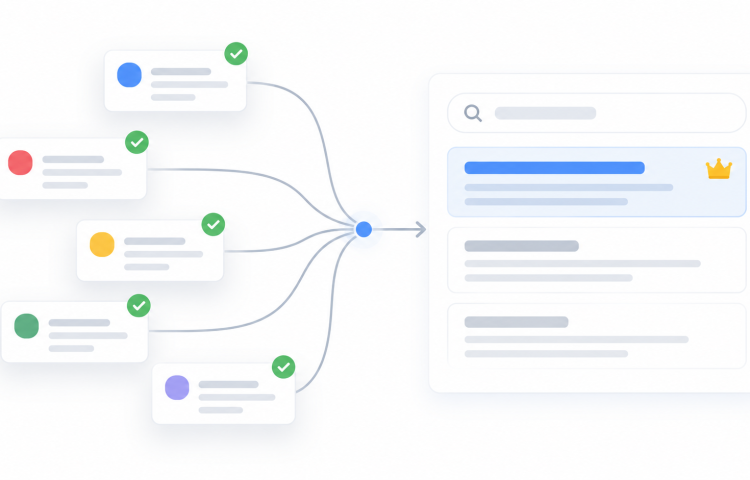
In its simplest form, consensus means that multiple sources agree about a fact, claim, interpretation, or recommendation. Search engines could use this agreement to help assess the reliability of information, particularly when a query involves factual claims that can be independently verified.
However, consensus is not a single, clearly defined technical concept. Several distinct mechanisms could fit the description:
- Scientific consensus: Agreement among credible scientific institutions, researchers, and established bodies of evidence.
- Expert consensus: Agreement among qualified subject-matter experts, recognized specialists, and professional organizations based on relevant expertise, evidence, and practical experience.
- Web consensus: Agreement among multiple independent documents or websites discussing the same subject.
- Internal consensus: Consistency among statements published across a single website, including its articles, documentation, product pages, and other resources.
- Authority consensus: Agreement between a document and authoritative information published by the organization, brand, institution, or individual responsible for the subject.
These forms of agreement are related but not interchangeable. A scientific claim supported by decades of research presents a different consensus problem from a question about which accounting software is best or how to configure a Shopify store.
It is also important to distinguish consensus from truth. Numerous websites can repeat an incorrect claim, while a single expert or firsthand source can provide accurate information that contradicts the prevailing view. Any consensus-based system must contend with this problem.
The Timeline of Consensus in Google Search
2017–2021: Consensus Likely Appeared in the Quality Rater Guidelines During This Period, If Not Earlier
The July 2017 edition of Google’s Search Quality Evaluator Guidelines provides a useful starting point for investigating the history of consensus. Subsequent editions were published in June 2018, May and December 2019, October 2020, and October 2021.
During this period, Google’s quality-assessment framework placed substantial emphasis on the accuracy, expertise, and trustworthiness of content. These considerations were particularly important for Your Money or Your Life (YMYL) topics, where inaccurate information could affect a person’s health, financial security, safety, or well-being.
The working historical hypothesis is that explicit consensus-related guidance was introduced into the QRG during this period, potentially in the 2017 edition or earlier. However, the exact first appearance has not been established here through a complete, version-by-version comparison of the archived documents. The period should therefore be treated as an investigative starting point rather than a verified date of introduction.
The distinction matters because Google’s public guidelines explain how human quality raters should evaluate search results. They are not a direct blueprint of the ranking algorithm. Google has repeatedly explained that ratings from individual quality raters do not directly determine the ranking of a particular page.
Nevertheless, the guidelines can offer useful insight into the kinds of quality problems Google seeks to address. If the guidelines instruct raters to consider expert consensus, that establishes consensus as a relevant quality-assessment concept, even if it does not establish a corresponding algorithmic ranking signal.
For historical reference, archived versions of the guidelines are catalogued in this Search Engine Roundtable overview of QRG updates.
August 2022: Marie Haynes Connects Google’s Consensus Announcement to the Quality Rater Guidelines
On August 11, 2022, Google publicly announced an improvement to featured-snippet callouts using its Multitask Unified Model (MUM). The announcement was significant because Google explicitly described a system that could assess whether multiple high-quality sources agreed on a fact.
According to Google’s explanation, its systems could check a featured-snippet callout against other high-quality sources to determine whether a general consensus existed, even when those sources expressed the same idea using different words or concepts.
Google said this consensus-based technique had meaningfully improved the quality and helpfulness of featured-snippet callouts.
On August 15, 2022, Marie Haynes published “What SEOs can learn about aligning with consensus as described in Google’s QRG” in Search Engine Land. Haynes connected Google’s announcement to existing language in the Quality Rater Guidelines and explored the implications for SEO.
Her analysis helped bring the subject into broader SEO discussions. The important insight was that consensus was not merely a theoretical idea: Google had publicly described using an AI model to compare a specific search feature against other high-quality sources.
However, the scope of Google’s announcement was specific. It described improving featured-snippet callouts, not a universal consensus score applied to every page in organic search.
Google had also previously discussed expert consensus in its featured-snippet policies. Its 2019 explanation of how Search stays relevant and useful noted that featured snippets on public-interest topics should not lack expert consensus. This provides additional historical context: consensus was relevant to Google’s treatment of certain search features before the 2022 MUM announcement.
Sources: Google’s August 11, 2022 announcement and Marie Haynes’s Search Engine Land article.
2023–2024: Joe Youngblood Hypothesizes a Broader Role for Consensus
Following Google’s Helpful Content Update and subsequent core updates, SEO practitioners debated whether Google’s systems were evaluating content quality in ways that extended beyond individual-page relevance.
Joe Youngblood explored the possibility that consensus could play a broader role in this process. In his article “Google and the Death of Originality,” published October 30, 2024, he argued that consensus might have expanded beyond featured snippets into broader content evaluation and potentially the systems associated with helpful content.
Youngblood’s hypothesis was that Google’s systems might compare documents against a model of established facts or wider agreement across the web, potentially disadvantaging content that substantially diverged from sources the systems considered authoritative.
He raised a legitimate concern about the limitations of such an approach. If a search engine overweights agreement with established publishers, it could struggle to distinguish genuinely inaccurate information from original reporting, unusual but valid opinions, firsthand experience, or well-supported challenges to conventional wisdom.
Youngblood also discussed how a consensus-oriented system might favor larger or more prominent websites if those sites exerted disproportionate influence over the perceived consensus.
These are important hypotheses, but they should not be mistaken for confirmed descriptions of Google’s algorithm. Observed ranking losses, correlations with other updates, and individual case studies cannot independently establish that consensus caused those changes.
Youngblood’s work belongs in the chronology because it articulated a theory of broader algorithmic application before the December 2024 discovery of a consensus-related internal property brought renewed attention to the subject.
December 2024: Mark Williams-Cook Discovers a Possible Consensus-Scoring Property
In December 2024, SEO researcher Mark Williams-Cook identified a vulnerability that exposed internal Google properties. Search Engine Land reported that the discovery revealed more than 2,000 properties associated with search classifications and scoring, including one described as consensus scoring.
The reporting indicated that the mechanism involved counting passages that agreed with, contradicted, or remained neutral toward a general consensus, with a consensus score generated from those relationships.
This was an important development because it provided evidence of an internal property explicitly associated with consensus scoring. It made the idea of machine-assessed agreement more concrete than a discussion based solely on the QRG or Google’s featured-snippet announcement.
However, several questions remain unresolved:
- Does the property participate in live production ranking, or is it used for another purpose?
- Which types of queries or content can trigger it?
- Does it influence organic rankings, featured snippets, query interpretation, or another component of Search?
- How much weight, if any, does the score carry relative to other signals?
- Does the mechanism assess scientific consensus, agreement among websites, internal consistency, or several types of agreement?
The existence of an internal property does not, by itself, answer these questions. Nor does it establish that a page that disagrees with prevailing opinion will necessarily rank lower.
Source: Search Engine Land’s December 16, 2024 reporting on the Google exploit and consensus scoring.
2025–2026: Consensus Building Becomes an AI Search Optimization Hypothesis
As generative search experiences have become more prominent, consensus has attracted attention beyond conventional Google rankings. SEO practitioners have begun investigating whether repeated, independently corroborated mentions of a brand, product, or recommendation can affect the likelihood that an LLM includes that entity in an answer.
Joe Youngblood has also discussed consensus building as an approach to AI search visibility. In a later discussion, he described a case in which an indexable question-and-answer conversation included a business among recommended options, followed by additional contributions from other participants.
Such observations can motivate useful experiments, but they do not establish a universal mechanism. An LLM may mention an entity because it encountered relevant text, because the entity appears frequently in its training data, because a retrieval system found a useful page, or because several independent sources corroborate the same information.
Different systems may use different retrieval methods, ranking functions, training data, and source-selection processes. A technique that appears to influence one AI product may have little effect on another.
For that reason, consensus building should currently be treated as an experimental approach to visibility, not a proven Google ranking technique or a guaranteed method of gaining citations in AI-generated answers.
How Might Google Technically Determine Consensus?
Google has publicly described one implementation of consensus assessment for featured snippets, but the available public evidence does not establish the exact architecture of a broader consensus-scoring system. The following are technically plausible approaches, not claims about Google’s confirmed implementation.
1. Extracting Claims and Comparing Their Meaning
A search system could identify the central claim in a passage and compare it with passages retrieved from other documents. Natural language processing and language models can help determine whether two statements express the same proposition despite using different vocabulary or sentence structures.
For example, consider these statements:
- “The Earth completes one orbit around the Sun in approximately 365.25 days.”
- “A year is about 365 and one-quarter days long.”
- “Earth’s orbital period is roughly 365 days and six hours.”
Although the wording differs, the underlying claims are substantially aligned. A system that compares semantic meaning rather than exact matching text could recognize this agreement.
Conversely, a claim such as “Earth orbits the Sun every 30 days” would contradict the other statements.
In technical terms, a model could classify relationships between claims as entailment, contradiction, or neutrality. It might also represent passages as vector embeddings and compare their semantic similarity. Similarity alone, however, cannot reliably establish agreement: two passages can discuss the same subject while making opposite claims.
2. Scientific Consensus
Scientific consensus is potentially the most straightforward application in areas where strong evidence and established expert agreement exist.
A system might compare a health-related claim with peer-reviewed research, systematic reviews, professional medical organizations, government health agencies, or other credible sources. It could then estimate whether the claim aligns with the prevailing scientific evidence.
This could help distinguish a well-supported medical explanation from a claim contradicted by a substantial body of research.
However, counting publications would be insufficient. A hundred low-quality pages repeating an unsupported claim should not necessarily outweigh a carefully conducted systematic review. A useful system would need to account for evidence quality, source independence, recency, expertise, and the strength of the underlying research.
Scientific consensus is also domain-specific. It is much more meaningful for an established scientific question than for subjective questions about taste, personal preference, or which product is best for a particular individual.
3. Expert Consensus
Expert consensus is agreement among qualified subject-matter experts, recognized specialists, or professional organizations based on relevant expertise, evidence, and practical experience. Unlike scientific consensus, which is grounded primarily in the body of scientific evidence, expert consensus can apply to fields where professional judgment and practical experience are important, such as software development, cybersecurity, engineering, and digital marketing.
A hypothetical search system could identify experts relevant to a particular topic, evaluate their qualifications and the credibility of their publications, and compare their conclusions about a specific claim. It might also consider whether experts independently reach similar conclusions, whether their recommendations are supported by evidence, and whether their positions reflect current professional standards.
For example, if several recognized cybersecurity researchers independently recommend a particular security practice, a system could potentially identify agreement among those experts. It might then compare a webpage’s recommendations with the broader body of expert guidance to assess whether its claims are consistent with established professional knowledge.
However, determining who qualifies as an expert is a difficult problem. Credentials, professional experience, publication history, demonstrated expertise, and the quality of supporting evidence could all be relevant, but none is sufficient in every context. A prominent expert can be mistaken, experts can disagree legitimately, and consensus can change as new evidence emerges.
There is no public confirmation that Google calculates a general expert-consensus score for organic rankings or uses the specific mechanism described here. This is a technically plausible hypothesis, not a verified description of Google’s implementation.
4. Web Consensus and Reciprocal Rank Fusion
Another possibility is that a system could compare claims across multiple independently retrieved sets of documents. For example, it might retrieve passages using keyword search, semantic search, entity relationships, and specialized source collections, then evaluate whether those sources agree.
One relevant information-retrieval technique is reciprocal rank fusion (RRF). RRF combines ranked lists by assigning contributions based on where an entity appears in each list. An entity that ranks highly across several lists can receive a stronger combined score than one that ranks highly in only one.
Conceptually, a search system could use multiple retrieval methods to gather evidence about a claim, then evaluate agreement among the resulting passages. RRF could help combine retrieval results, while a separate model evaluates whether the claims actually agree.
These are two distinct operations. RRF merges rankings; it does not inherently measure factual agreement or determine which claim is true.
There is no established public evidence that Google’s reported consensus score specifically uses RRF. It is a useful technical analogy for understanding how evidence from multiple retrieval systems might be combined, not evidence of Google’s implementation.
For background, see the Google Cloud documentation on hybrid search and reciprocal rank fusion.
5. Internal Consensus Across a Website
A website can publish information about the same topic across many pages. Those pages might include tutorials, FAQs, product descriptions, technical documentation, support articles, videos, and editorial content.
A hypothetical system could compare these materials to determine whether they are internally consistent.
For example, a company might publish a tutorial explaining that its software supports a particular feature while its official documentation says that the feature is unavailable on the relevant plan. A discrepancy could indicate outdated content, an error, or a difference in context that needs explanation.
Internal agreement could help establish a coherent body of information about a subject. But internal consistency is not proof of accuracy: a website can repeat the same mistake across every page. Nor is every apparent contradiction necessarily a problem. Product capabilities change, exceptions exist, and different pages may address different circumstances.
There is no confirmation that Google applies a general, sitewide internal-consensus score to websites. This is a possible model of how consistency could be assessed, not a verified ranking mechanism.
6. Authority Consensus Between a Document and an Official Source
A further possibility is that a system could compare a third-party document with authoritative information from the organization responsible for the subject.
Consider a tutorial explaining how to configure a Shopify store. If the tutorial describes a feature in a way that agrees with Shopify’s current official documentation, that alignment may help establish that the tutorial accurately describes the platform.
Similarly, a software review could be checked against official documentation to establish basic product facts, while an article about a government service could be compared with the relevant agency’s published requirements.
This should not be interpreted as a recommendation to copy brand documentation or always agree with a company. Official sources can omit limitations, use promotional language, or contain outdated information. Independent testing and firsthand experience may reveal facts that official materials do not disclose.
A sensible information-quality system would distinguish between a factual discrepancy and a justified criticism. It would also need to account for source authority in context: an official company page may be authoritative about its own product specifications, but it is not automatically the most reliable source for an independent assessment of the product’s quality.
Again, this type of authority consensus remains a hypothesis about a possible mechanism. It has not been established as a specific Google ranking factor.
Does Consensus Apply Only to YMYL Topics?
This is one of the most important unanswered questions.
There are clear reasons for a search engine to care about consensus on YMYL topics. An inaccurate medical or financial claim can cause serious harm, and established expert agreement can provide useful context when evaluating competing claims.
Google’s 2022 announcement, however, described consensus in the context of featured-snippet callouts without limiting the concept to YMYL queries. The December 2024 reporting about an internal consensus-scoring property also does not, by itself, establish that the mechanism is restricted to YMYL.
It remains unknown whether consensus scoring, if used in ranking, is limited to sensitive topics, applied to selected factual queries, or used more broadly.
The distinction between factual and subjective queries may be particularly important. Consensus about the boiling point of water is fundamentally different from consensus about the best restaurant in a city. In the latter case, apparent agreement may reflect popularity, advertising, review manipulation, geographic bias, or shared preferences rather than objective quality.
It is also possible that different systems use different forms of consensus for different purposes. A method used to validate a featured-snippet callout need not be the same method used to rank documents or generate an AI answer.
How Websites Might Benefit From Consensus if It Is a Signal
The following recommendations are not proven ranking techniques. They are practical experiments based on the possibility that Google or AI retrieval systems reward accurate, corroborated, internally consistent information.
1. Publish Verifiable Claims With Strong Evidence
Identify the factual claims that matter most in your content and make them easy to verify. Where appropriate, cite original research, official documentation, primary sources, recognized standards, or other high-quality evidence.
Do not add citations merely to make a page look authoritative. The sources should genuinely support the statements being made. If evidence is mixed or uncertain, explain that uncertainty rather than presenting an unsettled question as a proven fact.
If consensus matters to search systems, evidence-backed content may be easier to validate than content that offers unsupported assertions.
2. Build a Coherent Knowledge Base Across Your Website
Review important claims across your site’s guides, FAQs, product pages, documentation, and other resources. Ensure that related pages use consistent terminology and describe the same facts accurately.
Where information differs because of dates, plans, versions, jurisdictions, or other conditions, explain those differences explicitly.
For example, instead of publishing one page that says a feature is included in every subscription and another that says it requires an enterprise plan, specify which plans support the feature and when the information was last verified.
This improves the usefulness of the website regardless of whether Google uses an internal-consensus score. It may also make it easier for retrieval systems to extract accurate passages from different pages.
3. Establish Clear Relationships With Authoritative Sources
When writing about a third-party product, platform, regulation, or technical standard, identify the official sources that establish basic facts. Compare your content with those sources and correct genuine errors.
For example, a Shopify tutorial can link to the relevant official documentation while adding original screenshots, tests, examples, troubleshooting steps, and practical observations.
The goal is not to duplicate official content. It is to combine a reliable factual foundation with independent value. If an official source is incomplete or incorrect, explain the discrepancy and provide evidence rather than silently repeating the error.
4. Earn Independent Corroboration Across the Web
Develop original research, useful tools, expert commentary, and resources that other credible websites have a reason to reference. Independent mentions can help establish that a brand or claim is recognized beyond its own website.
For businesses seeking recommendations in AI-generated answers, this might include being discussed in relevant industry publications, professional communities, comparison articles, and genuinely independent customer discussions.
Independence matters. Ten pages controlled by the same organization do not provide the same corroboration as ten genuinely independent sources. Repeated mentions, copied content, fabricated reviews, and coordinated attempts to manufacture agreement do not establish factual truth.
If a search or AI system considers agreement among sources, legitimate third-party corroboration is a reasonable area to investigate. However, no specific number of mentions, referring domains, or citations has been established as a consensus threshold for Google.
5. Make Original Research Easy to Evaluate
Consensus should not mean that every publisher must repeat what already exists. Original research can be valuable precisely because it introduces new evidence or challenges an established assumption.
When publishing original findings, explain the methodology, sample size, limitations, dates, and conditions under which the results were obtained. Provide supporting data where appropriate and distinguish observed results from interpretation.
If your findings contradict established knowledge, acknowledge the existing evidence and explain why your results might differ. Consider whether the disagreement reflects a new discovery, a different population, a narrower context, a methodological limitation, or an actual error.
This approach allows readers and automated systems to evaluate the evidence without requiring blind agreement with existing sources.
6. Structure Content So AI Systems Can Identify the Facts
LLMs and retrieval-augmented generation systems may select passages from webpages to answer specific questions. Clear headings, direct answers, descriptive terminology, accessible tables, and well-defined entities can make content easier to interpret and retrieve.
For example, a product comparison should clearly identify the products, the evaluation criteria, the testing conditions, the date of the comparison, and the evidence supporting each conclusion.
Where a claim depends on context, state the conditions explicitly. A recommendation that is appropriate for a small business may not apply to a large enterprise.
These practices can improve clarity and extractability. They do not guarantee that Google or an LLM will retrieve, cite, or recommend the page.
7. Measure Visibility Rather Than Assuming Consensus Works
Websites interested in testing consensus-related strategies should establish a baseline before making changes.
- Track organic rankings, impressions, clicks, and featured-snippet visibility for relevant queries.
- Monitor whether important factual pages are indexed and whether search results reflect their intended subject.
- Record whether the brand appears in AI-generated answers for a consistent set of relevant prompts.
- Distinguish mentions from citations, and record whether the AI system actually links to the website.
- Compare results over time while accounting for content changes, algorithm updates, competitors, and other possible explanations.
Where feasible, test a specific intervention against comparable pages or topics that have not received the same treatment. Avoid changing every page at once if the objective is to identify what caused a result.
Even well-designed experiments may not reveal Google’s internal mechanisms, but they can help determine whether a strategy improves actual visibility for a particular website.
Could Consensus Become a Form of Entity or Brand Authority?
One possible extension of the consensus hypothesis concerns the relationship between entities and the information associated with them.
Imagine a software company whose product capabilities are described consistently across its documentation, independent reviews, technical tutorials, and industry discussions. A search or AI system might find it easier to associate the company with those capabilities than if the available information were sparse, contradictory, or ambiguous.
Similarly, when a business is independently recognized as a leading option in a particular category, corroborating evidence across credible sources could help AI systems understand its relevance to recommendation queries.
This does not establish that Google calculates a consensus-based entity-authority score. Entity recognition, source authority, link analysis, relevance, and retrieval quality are distinct concepts that may interact in complex ways.
Nor does it mean that a brand becomes authoritative simply because many websites mention it. The nature of those mentions, the credibility of the sources, the specificity of the claims, and the evidence supporting them all matter.
For LLM visibility in particular, different systems may draw on different indexes, retrieval sources, training data, and ranking mechanisms. A brand’s visibility in one system cannot be assumed to transfer to another.
The Risks of Optimizing for Consensus
There is a serious downside to treating consensus as a goal in itself.
If publishers optimize for agreement rather than accuracy, the web could become more repetitive and less informative. Smaller publishers may be discouraged from publishing useful firsthand experience or challenging claims repeated by larger websites.
Consensus can also be manufactured. Content farms, coordinated reviews, copied articles, and networks of mutually reinforcing websites can create the appearance of agreement without independent evidence.
Even genuine consensus can be wrong or incomplete. Scientific understanding changes, product documentation becomes outdated, and widely repeated claims can persist long after their original basis has been disproven.
For these reasons, the most defensible strategy is not to conform to whatever appears most frequently online. It is to publish accurate information, support important claims with evidence, acknowledge disagreement, and make original findings independently verifiable.
Conclusion: Consensus Is a Credible Research Hypothesis, Not a Confirmed Universal Ranking Factor
The history of consensus in Google Search contains several distinct milestones. The 2017–2021 QRG period is a reasonable starting point for investigating when consensus-related guidance first appeared, although the exact first edition has not been verified here. Marie Haynes connected Google’s public explanation of consensus-based featured snippets to the QRG in August 2022. Joe Youngblood subsequently argued that consensus might have a broader role in content evaluation. In December 2024, Mark Williams-Cook’s discovery of an internal property associated with consensus scoring added further evidence that Google has explored or implemented consensus-related mechanisms.
What remains unknown is more consequential than any individual milestone:
- Is consensus a general organic ranking signal? This has not been established.
- Does consensus influence rankings beyond YMYL topics? The available evidence does not settle the question.
- How does Google determine consensus? Its featured-snippet announcement provides one example, but the full technical implementation is unknown.
- How much influence does consensus have? No reliable public evidence establishes its weight relative to other signals.
- Can websites deliberately optimize for it? Several reasonable approaches can be tested, but no consensus-specific SEO technique has been proven to improve rankings.
The strongest practical conclusion is that accuracy, transparent evidence, coherent documentation, independent corroboration, and clear communication are worthwhile regardless of whether consensus is a direct ranking factor. These qualities can help users evaluate information and may help search and AI systems interpret it.
The objective should be to earn agreement through reliable information, not manufacture agreement to influence an algorithm. Until stronger evidence emerges, consensus should be treated as a promising research hypothesis in SEO and AI search—not as a confirmed ranking factor with a known formula.
Sources and Further Reading
- Search Engine Roundtable: Google Search Quality Rater Guidelines update history
- Google: How we keep Search relevant and useful
- Google: New ways we’re helping you find high-quality information (August 11, 2022)
- Marie Haynes: What SEOs can learn about aligning with consensus as described in Google’s QRG (August 15, 2022)
- Joe Youngblood: Google and the Death of Originality (October 30, 2024)
- Search Engine Land: Exploit reveals how and why Google ranks content (December 16, 2024)
- Google Cloud: Hybrid full-text and vector search, including reciprocal rank fusion